The Tape in the Safe
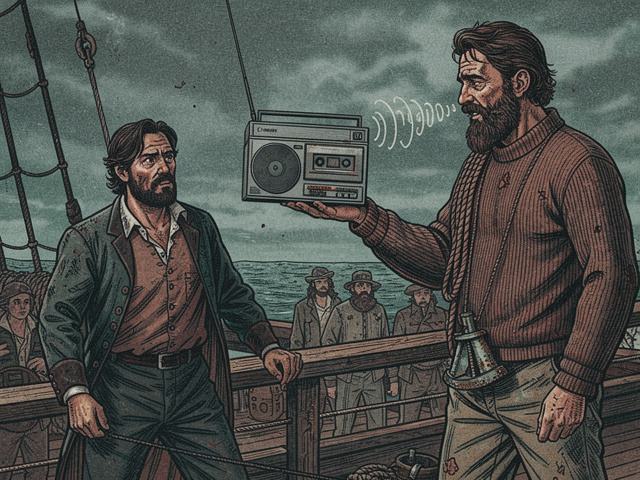
The hum of the engines was the first sound that truly belonged to the sea. It vibrated through the steel deck plates, a deep resonant thrum that never quite left the soles of my feet. New Bedford was a receding smear of lights by the time I finally made my way below, the cold Atlantic spray a fine invisible mist on my face, salt-sharp on my lips. The Pequod, for all her rust and ancient lineage, felt alive, breathing a mechanical breath of diesel and brine.
I found myself leaning against a bulkhead in the narrow passage leading to the mess, my cassette recorder held loosely in my hand, not yet running. The blank tape inside felt like a promise and a burden. I was here to document, to understand, but mostly to lose myself.
The summons came not long after dawn—a clipped order passed by a steward to report to the bridge. The air was already thick with an unspoken tension, a nervous energy that settled on the ship like cold fog. Starbuck, his face etched with the weariness of a man who'd seen too many false dawns, was already there, leaning over a chart table, tracing invisible lines with a calloused finger. Stubb nursed a mug of something dark and strong, slouched in a swivel chair, his gaze fixed on the grey expanse beyond the reinforced glass. Queequeg stood near the radar console, his hands—usually busy with the ship's guts—now still, resting on the cold metal. Fedallah, a lean shadow in the dim light of the bridge, hovered over a bank of sophisticated electronics, a strange silent sentinel.
Ahab entered, not striding but moving with a deliberate heavy gait that seemed to displace the air itself. His eyes, the color of storm-tossed sea, swept over us, devoid of warmth or welcome. He walked to the main console, a console far newer and more complex than anything else on the ancient bridge, a stark testament to the collision of eras aboard the Pequod. His hand, gnarled and powerful, went to a small heavy safe bolted beside it. A combination lock clicked softly. The safe door swung open, revealing not logs or charts but a small custom-built cassette player, sleek and black, unlike anything you'd find in a hi-fi store. Beside it, a single unmarked cassette tape.
"Gentlemen," Ahab's voice was a low growl, raw as barnacles scraped from a hull. "The reason we are here."
He took the tape, slid it into the deck. My own recorder felt heavy in my hand. I flicked the record switch. The faint whir of its internal motor was drowned out by the click of Ahab pressing play.
A moment of silence, and then it came.
It wasn't just sound—it was an echo, deep and vast, resonating with an almost supernatural clarity. A series of clicks, distinct from any whale song I'd ever studied, followed by a low mournful pulse. It built, then faded, an auditory sonar ping that somehow painted a picture in the mind: immense, solitary, utterly indifferent. It was the white sound, not because it was high-pitched but because it felt devoid of color, of life, of everything but an ancient terrible purpose. It carried the weight of the ocean itself, the profound silence of its deepest trenches. It was Moby Dick. The recordings I'd heard in university labs were clinical, scientific. This was primal.
The sound swelled again, a percussive beat followed by a long drawn-out groan that seemed to reverberate in my bones. It felt like the call of a ghost, the echo of something that shouldn't exist, a titan moving through the dark. It filled the small tense space of the bridge, making the metal shudder, making my ribs ache with its frequency.
Ahab stood before us, his back to the console, watching our faces. The single exposed limb of his leg, carved from what looked like dark polished lignum vitae, seemed to tap a silent rhythm against the deck. "Three years ago," he said, his voice cutting through the whale's lament, "this whale tore the sonar array from the Essex off the Kerguelen Plateau. Crushed the bows of the Argo in the Tasman Sea six months later. And it took my other leg." His eyes burned with a cold clear fire. "This is not just a whale. This is Moby Dick. And Moby Dick"—he paused, letting the whale's mournful call fill the void—"will be ours."
He pressed stop. The abrupt silence was almost louder than the sound itself.
Stubb let out a nervous chuckle, the sound brittle and out of place. "Permission to speak freely, Captain?"
Ahab's gaze was a physical thing. "Granted, Mr. Stubb. But choose your words wisely."
"Just... a whale, sir? Begging your pardon, but we've got a quota to meet. We're chasing blubber, not legends. That sound, it's... big. And mean. And sounds like a waste of fuel."
Ahab's lips thinned. "This vessel, Mr. Stubb, carries the most advanced long-range sonar and satellite tracking ever installed on a whaling ship. We have Fedallah here"—he gestured to the Iranian, who gave a slight almost imperceptible bow—"who can read the deep as if it were a ledger book. We are equipped to hunt this whale. And this whale alone."
A silence descended, heavy and thick. Queequeg, his face unreadable, stared out at the grey waves, his eyes seeming to pierce the horizon. I felt a chill that had nothing to do with the sea air. This wasn't a whaling voyage. It was a crusade.
Then Starbuck, his voice low and steady, broke the spell. "With all due respect, Captain, the company's ledger book isn't looking good. We're running on fumes, sir, and I don't mean just the fuel tanks. The world's changed. These aren't the days of steam and sail, where a man could chase a single whale across the Pacific and still bring home a profit. We need to fill our holds with what we can get. Any whale, Captain. We can't afford to be particular."
Ahab turned, his gaze narrowing, locking onto Starbuck with an intensity that promised pain. "You mistake this journey, Mr. Starbuck. We are not here to fill our holds. We are here to claim what is owed."
"Owed?" Starbuck's voice rose, losing some of its carefully maintained composure. "Sir, my family back in Nantucket, they're owed a future. These men, they're owed their wages. This ship, she's owed a reason to keep her boilers lit. And that reason"—he gestured vaguely out at the unforgiving sea—"is a full tank of oil, no matter what leviathan it comes from."
"Leviathan." Ahab repeated the word, savoring its ancient weight. "Has many forms. But only one carries my mark." He took a step toward Starbuck, his prosthetic leg thudding against the deck. "Do you question my command, Mr. Starbuck? Do you presume to tell me the purpose of this voyage on my own ship?"
Starbuck met his gaze, unflinching for a moment, then his shoulders sagged almost imperceptibly. He was caught between his captain and his duty, between a madness he could not understand and a pragmatism he could not abandon. "No, sir," he said, the words heavy with resignation. "Only to remind you of the reality of our position. Of all our positions."
Ahab simply stared, a long unnerving silence passing between them. Then he turned back to the safe, carefully removing the tape and locking it away. The click of the safe door seemed to seal our fate.
"Dismissed," Ahab commanded, his voice cold, final. "Mr. Starbuck, you will set a course to the southwest. And you will ensure all sonar systems are operating at peak efficiency. We leave nothing to chance."
As the others filed out, their faces grim and thoughtful, I felt the distinct disorienting sensation of having stumbled into a story already written, a tragedy waiting to unfold. My tape recorder, still running, captured the low thrum of the Pequod's engines, the distant cry of gulls, and the unsettling silence that followed Ahab's declaration. I had come seeking anonymity, but it seemed I had merely exchanged one kind of burden for another. And the white sound, the echo of a monster, was already etched into the fabric of my own journey.