The Stowaway’s Confession
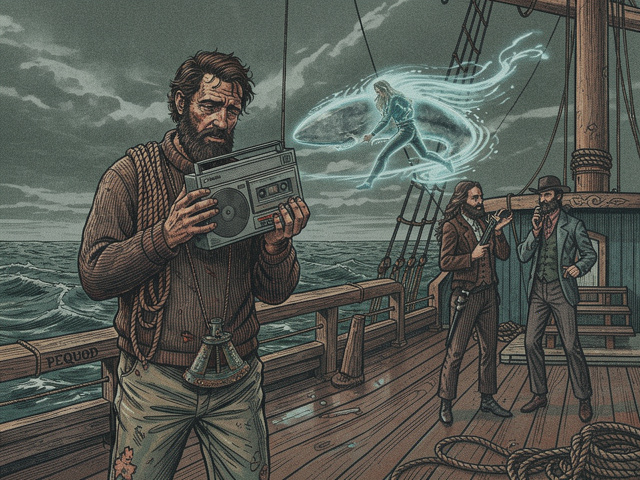
The ship's shuddering hum had become the default rhythm of my existence—a low, constant thrumming that worked its way into your bones, a sound that meant *going*, *moving*, *away*. After the satellite chase that yielded nothing but static and Ahab's tightened jaw, the Pequod felt like a coiled spring. We were adrift, not just on the ocean, but in the widening chasm between purpose and obsession.
I'd spent the last few watches down in the bowels of the ship, cleaning the old sonar arrays—the same arrays that had picked up the White Whale's phantom echo in Ahab's tape. The equipment was battered, barnacle-scarred, but still humming with a desperate sort of life. My tape recorder, a trusty Marantz PMD221, was my constant companion.
"Log entry, 1985, October 14th," I mumbled into the microphone, the plastic warm against my palm. The salt air stung, but the metallic tang of the ship was stronger—diesel, brine, and old rust. "Day three at sea. No visible sign of Moby Dick. The mood is... tight. Starbuck's trying to keep us on course for a regular hunt, but Ahab's shadow stretches long over the bridge. It's like we're sailing with a ghost in the captain's chair."
I clicked off the recorder and pocketed it. My wanderings often led me to the less-trafficked corners of the Pequod, places where the ship's true age and desperation showed themselves most nakedly. Tonight, that brought me to a small, cluttered cabin near the ship's ancient radio room, a space Fedallah had claimed as his own. The door was ajar, spilling a sickly green glow into the passageway. The air crackled with ozone and something else—frankincense, maybe.
I peered in. Fedallah sat hunched over a workbench, a tangle of wires, circuit boards, and blinking LEDs surrounding him like a strange, metallic nest. He wore thick spectacles, the light reflecting off them making his eyes seem like alien orbs. An old CRT monitor displayed a complex waveform, jagged and erratic. Beside it, a cassette player much like my own but clearly modified whirred softly.
"Ishmael," he said, without looking up, his voice a low, raspy purr. "Come in. Don't hover like a jinn outside the tent."
I pushed the door open, the old hinges groaning. "Just... curious. What are you working on?"
He gestured vaguely at the screen. "A signature. The White Whale's song."
My breath hitched. "You mean you've isolated its frequency?"
Fedallah finally turned, his gaze sharp and unsettling. His beard was neatly trimmed, but his dark, intense eyes seemed to hold centuries of desert and sea. "Not just isolated. Understood. Every creature has a unique voice in the abyss. A fingerprint of sound. This whale has a voice unlike any other. Low, infrasonic. It resonates. A deep hum, almost beyond human hearing—the *felt* rather than *heard* vibration. A sound that carries for hundreds of miles. A whisper that can become a roar."
He picked up a smaller device, a black box with a single red dial and an antenna. "The old whalers spoke of a 'white sound' that filled the ocean when Moby Dick was near. They thought it was the whale's spirit. But it was this." He tapped the box. "A frequency so deep, so powerful, it disrupts everything around it. Modern hydrophones struggle with it. Too low. Too resonant. It creates a kind of acoustic shadow."
My mind raced. This was the missing piece. Ahab's tape hadn't just been an echo—it had been a key. "But how do you know this? Has he been tracked before with this frequency?"
Fedallah's lips curled into a faint, knowing smile. "Ancient knowledge, Ishmael. Passed down through generations. My people read the desert's pulse, the sky's whispers. The ocean is no different. Plus," he tapped the modified cassette player, "Ahab is not the only one with old tapes. Before the satellite, there were different ears listening." He paused, his smile fading. "This whale is not merely big. He is a force. He *knows*."
I felt a chill that had nothing to do with the drafty cabin. *He knows.*
Just then, a klaxon blared from the deck above—a short, sharp burst. "Starbuck's calling a briefing," Fedallah said, already turning back to his work, dismissing me. "He wishes to talk of lawful enterprise." The last word was laced with dark amusement.
The klaxon was Starbuck's way of asserting control, his attempt to drag the Pequod back into the realm of regulated reality. I found him in the cramped mess hall, a faded nautical chart spread across a grimy table. Starbuck, solid and earnest, pointed a gnarled finger at a cluster of red marks.
"Alright, listen up!" he barked, his Nantucket accent thick. "Satellite data, for all its damn fuss, *did* pick up a migration pattern for common sperm whales about two hundred miles southwest. Not Moby Dick, no, but a good pod. We're behind schedule, and frankly, the freezer's looking emptier than a preacher's purse on Sunday. We'll set a course, run parallel, and aim for a regulated catch. Three good males, maybe a female if she's past breeding age. Standard quotas, standard procedure. We fill our holds, we make our money, we head home. No heroics. No chasing phantoms."
A ripple of relief, faint but visible, went through the crew gathered around. Stubb, nursing a mug of something suspiciously dark, offered a sarcastic cheer. "Hear, hear, Starbuck! Rationality on the Pequod—wonders never cease! Maybe we can even get a good night's sleep without listening to Captain Ahab whisper sweet nothings to a whale tape."
Ahab himself wasn't present, a fact that usually allowed for a brief respite from the ship's suffocating intensity. But his spirit still hung heavy.
"Queequeg," Starbuck continued, "I want your harpoon team ready. Stubb, you're on bridge watch. Ishmael, be ready with the blubber hooks and flensing gear." He looked around, his gaze settling on the doorway. "Anything to add, Captain?"
Ahab emerged from the shadow of the passageway, a gaunt, formidable figure. His face was etched with a lifetime of sun and salt, his eyes holding the glint of distant ice. He said nothing, simply leaned against the doorframe, one hand resting on his ivory leg. The very air seemed to thicken.
"Sir?" Starbuck pressed, his face tightening. "The plan is to head southwest. A controlled hunt. I've plotted the coordinates."
Ahab straightened, his gaze sweeping over the crew, lingering for a moment on each face—a silent assessment. He finally fixed his eyes on Starbuck. "A good plan, Mr. Starbuck," he said, his voice low and raspy, yet carrying an undeniable authority. "A sound, lawful plan."
Starbuck nodded, a flicker of hope in his eyes.
"However," Ahab continued, his voice dropping another notch, "I received a new transmission. A faint but unmistakable signature from the deep. A resonance, unique. It suggests a solitary wanderer, moving west-northwest. A whale of significant size. And value."
My stomach clenched. *The unique frequency. Fedallah.*
Starbuck's face fell, his shoulders slumping just a fraction. "Sir, with all due respect, that's anecdotal. The satellite data for the pod is current. This 'resonance' could be anything."
Ahab merely smiled, a thin, humorless line. "A true whaler, Mr. Starbuck, learns to trust the old ways. The ocean whispers to those who listen. I believe this 'solitary wanderer' to be the very whale we seek. And its path, I must insist, takes us west-northwest."
He didn't give an order, not directly. He didn't countermand Starbuck's plan. He simply stated a new truth, an irrefutable fact based on his own, unverified source. The unspoken implication was clear: the Pequod would follow his whisper, not Starbuck's data.
"But the quotas—" Starbuck began, his voice strained.
"The greatest quota," Ahab cut him off, his eyes burning, "is vengeance. The greatest prize, the knowledge that we stood against the leviathan and won. Set the course, Mr. Starbuck. West-northwest. Full steam ahead."
He turned and limped away, his ivory leg thudding against the deck, the sound echoing the finality of his command.
Starbuck stood frozen, the nautical chart before him now just a piece of paper, his carefully laid plans dissolving like sea foam. He ran a hand through his hair, his frustration a palpable weight in the air.
Stubb let out a slow, deliberate sigh. "Well, there it is, boys," he drawled, pushing himself away from the table. "Starbuck tries to be a shepherd, but Ahab's always going to be the wolf. Looks like we're back to chasing shadows, only this time, the shadow knows our name."
Queequeg, who had been quietly sharpening a harpoon tip at the back of the mess, looked up. His dark eyes met mine across the room. He didn't speak, but in his gaze, I saw it: a profound, ancient sadness, and the stark, chilling realization that we were not just hunting a whale, but were, in fact, being hunted ourselves.
I walked back to my bunk, the hum of the ship now feeling less like movement and more like a snare drum, beating a slow, inevitable march. I pulled out my recorder.
"Log entry," I whispered, the tiny microphone picking up the tremor in my voice. "October 14th, evening. Ahab has found his ghost again. Or rather, Fedallah found it for him. The White Whale's frequency. A unique hum. And Ahab trusts his intuition more than any satellite, any logic, any legal quota. We're heading west-northwest. Away from the known, into the unknown. We're not just after a whale anymore. We're sailing into a confession of doom."
The red light on the Marantz glowed, silent witness to the Pequod's accelerating plunge into obsession.